
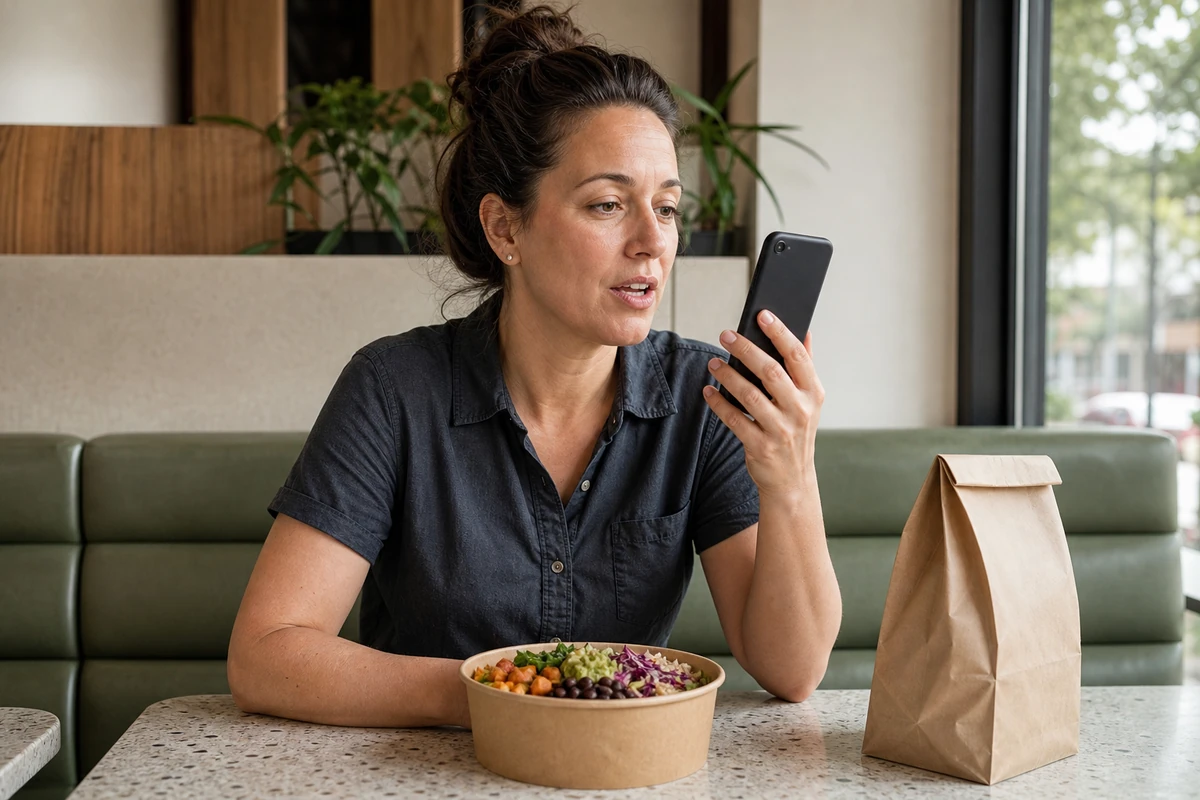
AI-generated editorial image. This illustrative scene is not a documented restaurant test or product session.
Before expanding AI ordering, test whether everyday spoken requests become the intended order. Include corrections, unavailable items and a clear route to a person. Compare the conversation, confirmed basket and fulfilled meal, then track completion and error recovery against your existing channel. Treat higher spend as useful only when guests receive what they meant to order.
Start with the conversation, not the sales promise
A guest says, 'No cheese. Actually, make that two bowls, but only one without cheese.' The useful question is not whether the assistant sounds friendly. It is whether the final basket, confirmation and kitchen instructions preserve the guest's meaning. A smooth conversation that produces the wrong meal is not a growth improvement.
In an October 9 QSR Magazine article, Katherine Roy describes conversational ordering, personalized recommendations and voice interfaces as possible ways to simplify ordering. She also emphasizes accuracy, privacy and human supervision. The article is contributed commentary; its author biography identifies Roy as a digital marketing specialist and links to Bytesflow, a digital-solutions provider. It does not establish a measured sales lift or accuracy benchmark for your restaurant.
The test plan below is our practical guidance, not a report of products we have tested. Its purpose is to find out whether a conversational channel helps more guests complete a correct order before you expose more customers to it.
Build a spoken-order test set from your actual menu
Choose one location, one ordering channel and a manageable group of items. Write down the expected basket before trying each request. Include sizes, quantities, permitted substitutions, current prices and unavailable choices. Ask someone who did not build the menu to speak naturally rather than read the interface's preferred wording.
Start with a simple order, then change one aspect of the request at a time. This makes a failure easier to diagnose. If the channel accepts voice, test the real device and service environment as well as a quiet room. If it accepts typed conversation only, test that actual path rather than assuming it has voice capability.
- Try everyday names for the same item, including a guest's plausible mispronunciation or informal description.
- Request different quantities and customizations for two otherwise similar items.
- Include a sold-out item, a request outside the menu and an interrupted or incomplete sentence.
- Repeat the same request with another tester; record the expected result and the observed result separately.
Test corrections and ambiguity before recommendations
Corrections deserve their own test. Try 'not large,' 'remove that,' 'change only the first one' and 'start over.' Check that an earlier choice is actually removed rather than left in the basket alongside its replacement. A confirmation should let the guest recognize the item, quantity, changes and price before committing.
When a request could mean more than one thing, look for a short clarifying question instead of a confident guess. For a test such as 'make it a combo,' define what the restaurant's menu allows and verify that the assistant asks about unresolved choices. The tool should not invent a dish, accept an impossible substitution or promise an unavailable item.
If the system makes suggestions, check them after the base order is correct. A suggestion should fit the available menu, show its price and be easy to decline. Do not judge success by add-on revenue alone if the assistant is also changing quantities or adding unwanted items.
Make the human exit easy to use
Test 'I need a person' as carefully as an item request. Decide where that request leads during actual opening hours, who receives it and what happens when no one is immediately available. Avoid a loop that simply repeats the same question or sends the guest back to the beginning without explaining the alternative.
A useful handoff should make clear whether an order exists, whether the guest has committed to it and what still needs confirmation. Do not let an unresolved conversation silently become a completed order. If your channel cannot transfer context, provide a clear fallback and measure the extra work rather than calling it seamless.
For allergy or safety-sensitive questions, do not treat an AI answer as verification. Follow the restaurant's established staff procedure and obtain the appropriate human confirmation before accepting the request. The guest needs an honest answer, not an automated assurance the restaurant has not checked.
Read back the complete order handoff
For each controlled test, compare the guest's intended request with the final basket, the confirmation the guest receives and the instructions available to the team preparing the food. Use a permitted test mode when available. If a real order is needed, coordinate it with the team and account for it rather than creating unannounced orders or avoidable waste.
Separate recognition failures from handoff failures. The conversation may understand 'one bowl without cheese' but lose the instruction later. Conversely, the downstream system may faithfully carry an order that the assistant misunderstood. Keeping those failures separate helps you ask the right question of the provider.
Also ask the provider what conversation data it collects, where that data goes, who can access it and how it is retained or removed. Use non-sensitive test requests. Do not include real guest contact details, payment details or private information in a test transcript, and keep customer-facing explanations consistent with the actual setup.
Measure completed correct orders and failed recovery
Once the controlled test is satisfactory, keep the initial guest trial narrow. Set a review window and stop conditions before launch. Compare similar service periods and record menu, staffing or promotion changes that could affect the result. A before-and-after difference is a signal to investigate, not proof that the assistant caused it.
Count conversations started, confirmed orders and fulfilled orders separately. An abandoned conversation may never reach an order report. Define a correct order using the guest's confirmed choices, not just the fact that a ticket exists. Keep human transfers visible rather than counting them as automatic completions.
Review results alongside corrections, repeated requests, transfers that fail, remakes, refunds and staff time spent resolving problems. Track order value only with those safeguards in view. A larger basket is not a win if it includes an unintended item or leaves a guest less willing to return.
- Before launch: record expected baskets, observed failures, fixes and the person responsible for each fix.
- During the trial: record completed correct orders, unresolved requests and successful versus failed human handoffs.
- At review: compare the existing channel with the trial, note important differences and decide whether to expand, revise or stop.
Expand only when the guest has a better path
Re-run the difficult requests after any menu, availability or configuration change. Fix the failures you can reproduce before adding another location or channel. If the assistant struggles with a particular task, keep that task on the established ordering path until the issue is resolved.
The growth case is straightforward: make it easier for a guest to finish the order they actually want, and protect their confidence in coming back. Let your own completion and service evidence decide whether AI belongs in that path. Novelty, fluent answers and a vendor demonstration are not substitutes for a correct meal and a usable way to get help.
Submit a restaurant or local business.
Share the business details, useful links, and what makes the place worth knowing for possible Restaurant Tech Report coverage.
FAQ
Does conversational AI ordering guarantee higher restaurant sales?
No. The cited QSR Magazine piece discusses possible applications and cautions, not a guaranteed outcome for your restaurant. Test completed correct orders, order value, errors and service recovery against a comparable existing channel before expanding.
What should a restaurant test before offering voice ordering?
Test real menu requests, quantities, corrections, unavailable choices, ambiguous wording and the route to a person. Compare the intended request with the confirmed basket and fulfilled order. Use the actual device and channel guests will use.
Should an AI ordering assistant answer allergy questions on its own?
Do not rely on an automated answer as verification. Follow the restaurant's established procedure and obtain the appropriate human confirmation for allergy or safety-sensitive requests. This article is general operational guidance, not individualized food-safety or legal advice.